What's your parenting personality? Take the quiz to find out!

What’s Wrong with Elf on the Shelf
The holiday season is once again upon us and with it comes a myriad of holiday traditions, from baking cookies to singing seasonal songs.
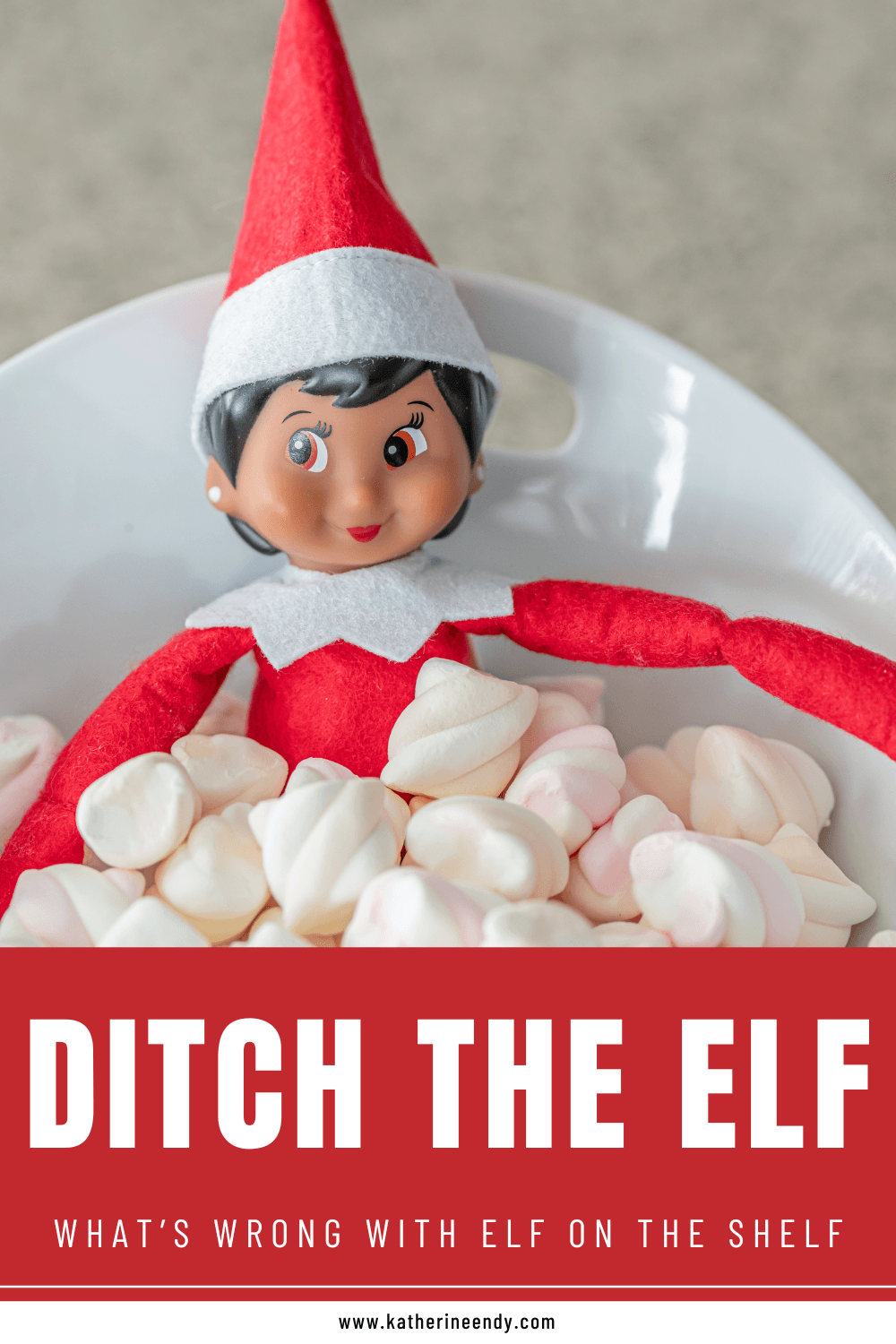
One such holiday “tradition” that trots out this time of year is the Elf on the Shelf.
Based on a 2008 children’s book by the same name, the Elf on the Shelf supposedly watches children from Thanksgiving to Christmas provides a daily behavioral report to Santa, determining whether the children are worthy of receiving gifts.
Parents might leave notes or little treasures “from the Elf,” praising or rewarding them for good behavior or offering reminders for how they could do better.
When I was a kid, my brothers and I each had an empty plastic Christmas ornament called an Elf Ball.
The concept was the same, but the elves were invisible.
If we were “good” we might find a sticker or a piece of chocolate in the Elf Ball.
If we had fought or gotten into a little trouble, the ball would be empty, and we would feel disappointment, devastation, and even shame.
The Elf on the Shelf feels even worse to me, with those creepy, beady eyes following you everywhere. The way the Elf mysteriously moves around the house, children never knowing where he’s going to pop up next.
The Elf on the Shelf is not a cute holiday tradition, it’s a creepy form of behavioral control.
Using rewards to reinforce behaviors that are desirable to adults not only misses inherent developmental realities that are beyond the child’s control, it erodes trust between the child and the adult.
Let’s start with the developmental aspect of things. This is actually very simple: child brains are different from adult brains, in that they are not fully developed.
The part that is still developing is the part that is responsible for, among other things, self-control. When we expect a 4-year-old or even a 7- or 10-year-old to control their own behavior – especially in heightened emotional situations like birthday gift disappointment or sibling fights – we are asking them to do something they are developmentally incapable of doing.
It’s like asking a 2-year-old to tie her shoes. You know a 2-year-old does not have the physical dexterity and hand-eye coordination to tie her own shoes, so you’d never ask her to do it, and you certainly wouldn’t get angry or punish her if you asked her to and she didn’t perform.
But a reward is not a punishment…I don’t see the problem.
A reward becomes a punishment when it is withheld.
If you get a sticker for cleaning your room, it’s a punishment to NOT get a sticker when you don’t clean your room.
The Elf on the Shelf is a punishment device.
Ok, but I leave a treat or a note, even when I didn’t like my kids’ behavior. It’s just for fun.
Some parents do not use the Elf to withhold rewards.
While this is slightly better than the manipulation of rewarding the “good” and not rewarding the “bad” behavior, it is still extremely problematic to set up surveillance in your own home.
Yes, the Elf on the Shelf creates a surveillance state in your home.
This might sound extreme, but I am not the only person to make this observation. Setting up a watcher to monitor your child’s behavior acclimates your child to being monitored at all times.
In a world where our smart phones are listening to our conversations and turning around and feeding us ads for products we’ve discussed and our words, ideas, and even emails are being used to train artificial intelligence, we have to think critically and be vigilant about protecting the privacy of our children.
I know many of you may be thinking “geez, lady! The Elf on the Shelf is just a fun, silly holiday tradition. Lighten up!”
To that I say, IS it fun?
I have never engaged in Elf on the Shelf (I’m sure you’re not surprised), but I gather from social media that the standards are high and the competition amongst parents can be intense.
The drive to create “magic” for our children and, let’s be real, to outdo our friends or followers on Instagram, can cause a lot of stress for parents (as if the holiday season is not stressful enough!)
More importantly, it is imperative that parents think critically about things we do that are “just for fun” that may have lasting consequences for our children.
Monitoring a child’s behavior is intrusive and creepy. Even if it’s not your intention, it teaches your child that they do not have a right to privacy and that their every move may be seen, recorded, and reported to the authorities. I know that is not what you want to teach your child.
Monitoring and rewarding behavior also creates shame.
We want our children to feel safe at home, and free to be themselves, even when they mess up, can’t control themselves, or do something unkind. Home should be a place where everyone in the family can show up as their whole selves and not have to worry that they’ll be judged or punished if they make a mistake.
I want all children to feel worthy of receiving good things – especially their parents’ love and approval – regardless of how they behave. I suspect that’s what you want, too.
Ditch the Elf and go bake some cookies together instead.
Ready to ditch punishment all together? Get my Alternatives to Punishment course for only $47! Learn more about the course here!
Follow Us


Sign up for Katherine's Monthly Conscious Parenting Newsletter!
Join our mailing list to receive CALMER Parenting Insights, my monthly parenting newsletter to help you shift your perspective and parent consciously. Don't worry, your information will not be shared.
We hate SPAM. We will never sell your information, for any reason.


© 2026 The Family Life Coach